Launching our Climate Transition Action Plan

After years of dedicated work and commitment to our Science Based Targets, we are proud to launch our Climate Transition Action Plan.

Climate Transition Action Plan Get Set Zero impact strand

Today marks a pivotal moment in the Useful Simple Trust’s sustainability journey. After years of dedicated work and commitment to our Science Based Targets, we are proud to publicly launch our Climate Transition Action Plan (CTAP).

This CTAP is a blueprint for transforming climate goals into measurable action – providing transparency on our carbon context, identifying our emission hotspots, and outlining our target pathway with specific actions for 2026.

Why This Matters

Whilst we recognise that our greatest impact is through our project work, we believe that every organisation has a responsibility to combat climate change. For us, reducing our impact aligns with who we are as a business; our Ethos and our status as B Corp, Social Enterprise, and Employee Benefit Trust.

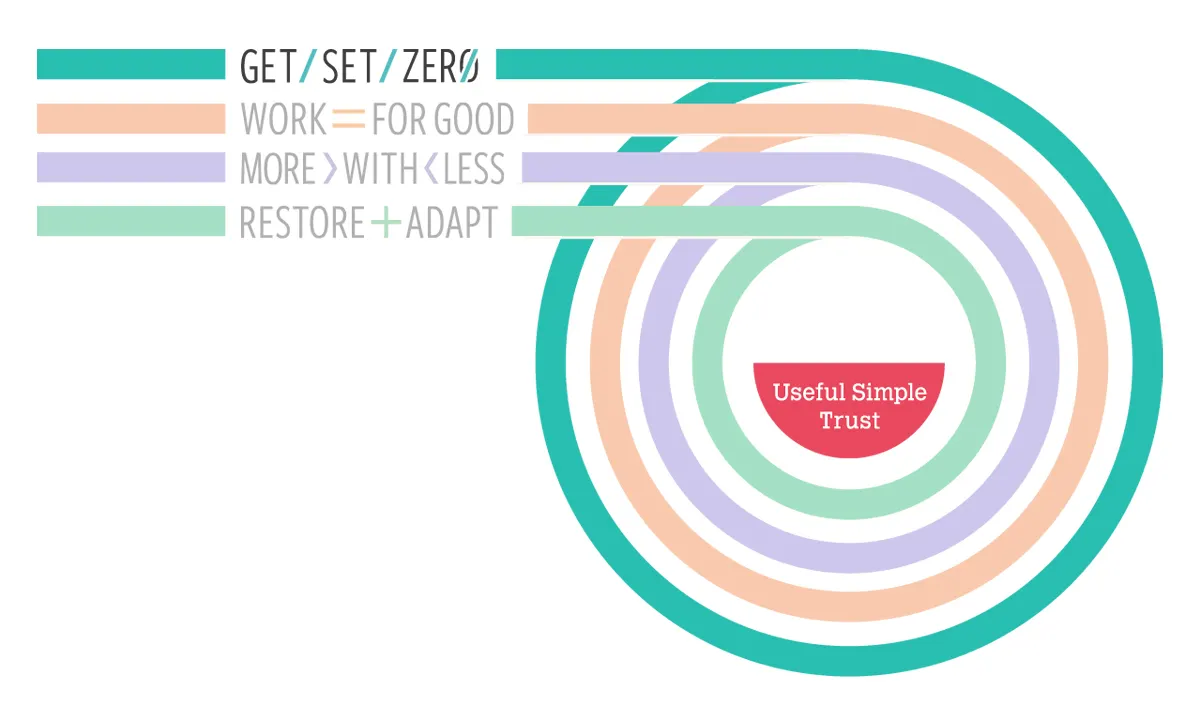
The Trust’s four Impact Strands – Get Set Zero, Work for Good, Restore and Adapt, and More with Less – knit together the projects and services our brands provide to clients. Our CTAP focuses on accelerated action towards net zero carbon in line with Get Set Zero, and provides a near-term roadmap aligned with the critical 1.5°C pathway following guidance from the We Mean Business Coalition.

Climate Transition Action Plan timeline and commitments

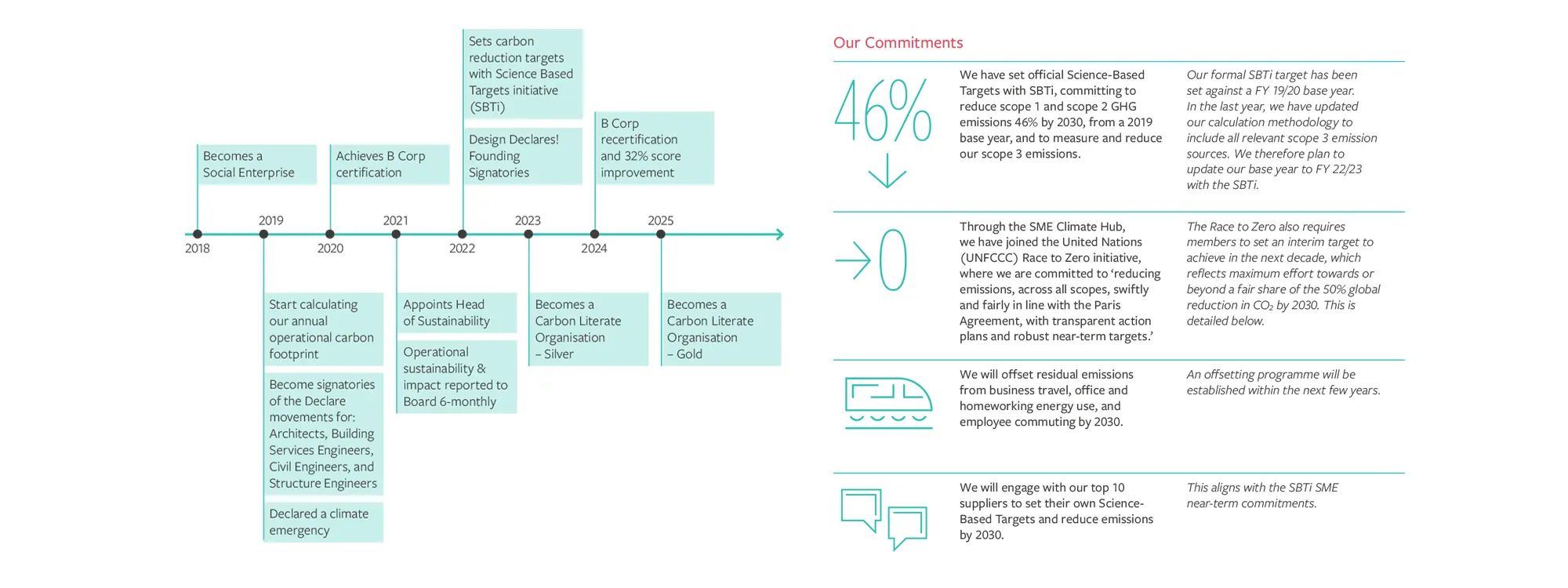
Our Journey

2018: Became a Social Enterprise

2019: Started calculating our annual operational carbon footprint

2020: Achieved B Corp status

2021: Appointed our Head of Sustainability, Carrie Behar

2022: Set carbon reduction targets with the Science Based Targets initiative (SBTi)

2023: Became a Carbon Literate Organisation – Silver

2024: B Corp recertification and 32% score improvement

2025: Became a Carbon Literate Organisation – Gold

Our Commitments

1. We have set official Science-Based Targets with SBTi, committing to reduce Scope 1 and 2 GHG emissions 46% by 2030, from a 2019 base year, and to measure and reduce our Scope 3 emissions.

2. Through the SME Climate Hub, we have joined the United Nations (UNFCCC) Race to Zero initiative, where we are committed to ‘reducing emissions, across all scopes, swiftly and fairly in line with the Paris Agreement, with transparent action plans and robust near-term targets’.

3. We will offset residual emissions from business travel, office and homeworking energy use, and employee commuting by 2030.

4. We will engage with our top 10 suppliers to set their own Science Based Targets and reduce emissions by 2030.

Discover how we are turning climate commitments into measurable action.

Advancing infrastructure through collaborative design

Championing a design rigour for road infrastructure that is climate resilient and regenerative for users, the natural environment, and place.

Design has the power to protect, enhance and restore communities and environments – a principle that drives Catherine Ramsden’s work as both Founding Director of Useful Studio and member of the National Highways’ Strategic Design Panel. Through this influential role, she champions a rigour for road infrastructure design that is climate resilient and regenerative for users, the natural environment, and the place.

Challenging conventions through collective expertise

Relaunched in November 2024, the Strategic Design Panel assembles specialists from architecture, engineering, landscape design, and social sustainability to challenge established practices and elevate design standards across the Strategic Road Network. This independent advisory body convenes quarterly, ensuring infrastructure projects demonstrate excellence while addressing complex environmental and social considerations.

The panel’s methodology prioritises transformative outcomes through:

  • Context-responsive development – designing infrastructure that enhances rather than diminishes local environments and communities,
  • Inclusive engagement – ensuring diverse voices shape transport infrastructure decisions,
  • Environmental stewardship – embedding sustainability principles throughout design processes,
  • Community-centered value – making infrastructure benefits tangible and meaningful to end users.

This approach transcends traditional mitigation strategies, positioning design as a catalyst for genuine value creation and positive societal impact.

Guided by ten principles of exemplary road design, the panel champions infrastructure that is inherently safe, inclusive, environmentally responsible and collaborative. By synthesising expertise across multiple disciplines, the initiative ensures England’s motorways and major A roads serve as a framework for community enhancement while protecting and enriching natural landscapes.

Explore the Strategic Design Panel‘s methodology and design principles.

Reflecting on the University Design Forum Annual Conference

Lily Bell and Electra Gkampoura share their key takeaways on how future-focused campus design doesn't require complexity.

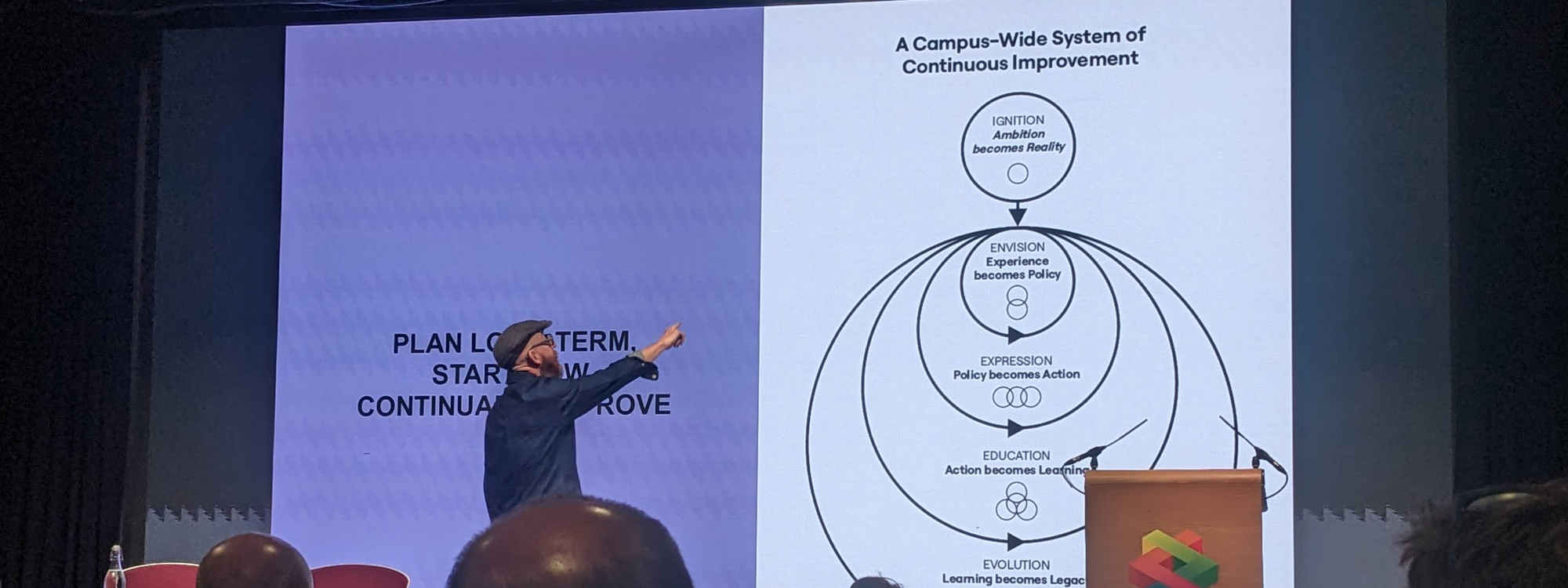
Presentation from the 2025 University Design Forum

Attending the University Design Forum Annual Conference last month left us with a lot to reflect on. Focusing on ‘Back to the Future: University Design: Past Present and Future’, we were challenged to think about how we shape places that continue to serve evolving communities over time.

One of the strongest provocations came from the Antwerp case studies. Simplicity and robustness in design deliver far more value, both socially and financially, than many of our more complex and costly buildings in the UK. Buildings constructed at around £2,000 per square metre using rectilinear forms, natural ventilation, and basic, well-detailed materials aren’t just cost-effective – they are better used.

The conference also reminded us that reuse has huge potential, whether of buildings, materials, or existing campus infrastructure. Some of the most successful spaces are the ones that have been made to work and repurposed with intention. Reimagining entrances or underutilised buildings can be more impactful than an expensive new build.

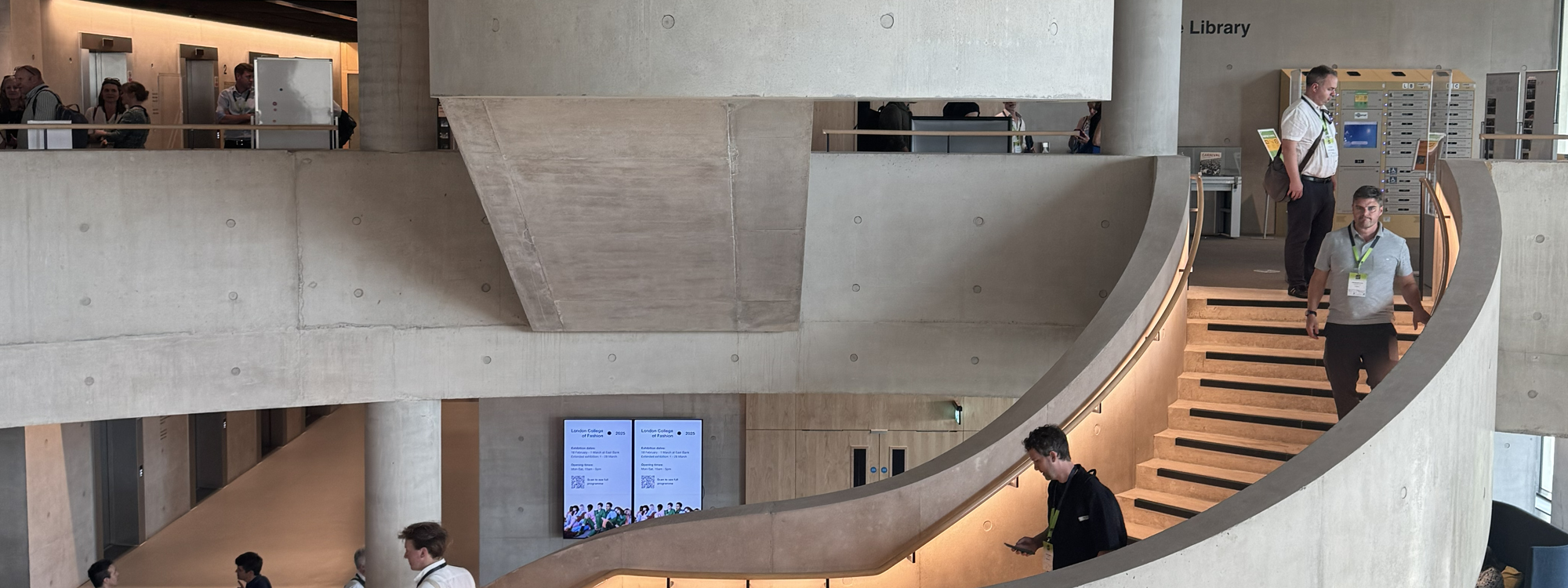
Cement spiral staircase at the 2025 University Design Forum

Design flexibility

Adaptability surfaced repeatedly. Are lecture theatres even necessary anymore? With declining on-campus attendance and a growing culture of digital flexibility, we are questioning the very spatial typologies we rely on. Reiach and Hall Architects reminded us that masterplanning should be about long-term frameworks, not fixed plans. Strategies must evolve with institutions and their communities, and remain open to engagement throughout their life. Adam Scott captured it perfectly: “Engagement first, red line last.”

Professor Peter Madden, OBE pushed us further when he asked what it really means to design for the future. Not the abstract future, but real, emerging trends like AI in education, holograms in lecture halls, declining birth rates, and rising temperatures. Reflecting on R. Buckminster Fuller’s saying, “We are called to be architects of the future, not its victim”, Madden posed the question: “Who are we designing for? Who owns the future?”. He argued that if we don’t shape it with intention, it will be shaped for us, more likely in ways that exclude rather than include.

For us as a studio, the key takeaway confirms that thoughtful, future-focused design doesn’t require complexity. Simplicity is often the most impactful strategy; with reuse delivering more value than starting from scratch and adaptability being embedded from the outset, not retrofitted later. Designing for the future means embracing uncertainty and designing spaces that continue to respond to their users, context, and purpose. We couldn’t agree more!

Read more about the key topics and expert lineup here.

UST wins ‘SME Employer Skills Champion of the Year’

Recognising our leadership in developing the next generation of engineering talent at the Enginuity Skills Awards.

The Useful Simple Trust has been awarded ‘SME Employer Skills Champion of the Year’ at the 2025 Enginuity Skills Awards, recognising our leadership in developing the next generation of engineering and manufacturing talent.

Each year, Enginuity celebrates the teams and individuals who inspire and empower the next generation of talent in the engineering and manufacturing sector, fostering a culture of innovation, diversity, and collaboration.

This prestigious award recognises the Trust for “demonstrating outstanding commitment to sustainable business improvement through targeted training programmes and strong industry partnerships. Their work aligns perfectly with Enginuity’s mission to close engineering and manufacturing skills gaps.”

This recognition validates our approach to skills development and industry collaboration. The Trust’s commitment to education and training stems from over 25 years of forward-thinking partnerships with educational institutions and industry leaders. Our Founding Directors established a clear vision that continuous learning should be central to everything we do, embedding this principle in our Ethos:

‘We will educate ourselves and others. To grow the next generation, we will play an active role in framing educational curriculum and make time to help deliver it.’

Investing in future skills for sustainable growth

The Trust’s work demonstrates how strategic investment in skills development creates lasting value for both industry and society. Through our comprehensive training programmes and collaborative partnerships, we are helping to build a more resilient and sustainable future for the sector.

The Skills Awards ceremony showcased exceptional talent across the industry, and we congratulate our fellow finalists at Reliance Precision Limited and DePe Gear Company for their outstanding contributions to skills development. Our thanks go to the Enginuity team, the inspiring finalists and winners, presenters Mohammed Taher and Mimi Nwosu, and category sponsor The National Network of Institutes of Technology for making the evening memorable.

Watch the awards ceremony on YouTube.

Our 2024-25 Impact Report is now available

Discover how collaborative innovation is transforming the built environment in our latest Impact Report.

The Useful Simple Trust is proud to share our 2024-25 Impact Report. This year we are focusing on the theme of ‘collaborative innovation’, showcasing how our work to unite diverse expertise and foster cross-industry partnerships is really delivering impact on the ground.

The built environment faces unprecedented challenges: achieving net-zero carbon emissions, adapting to climate change, addressing biodiversity loss, and meeting growing infrastructure demands within planetary boundaries. These systemic challenges cannot be solved in isolation. They require breadth of expertise, broad perspectives, and the collective drive to push for better outcomes.

Innovation through collaboration sits at the heart of everything we do. We believe progress happens faster when knowledge is shared, which is why we continue to invest in long-standing, cross-industry programmes that help drive transformation and practical education across the built environment. From pioneering industry-shifting innovation to advancing social value, our four collaborative innovation themes demonstrate how meaningful partnerships create solutions that ripple far beyond organisational boundaries.

This Report presents some of the achievements we are most proud to share with you, from our B Corp recertification with a 32% score improvement to the real-world impact of projects like the AVA Footbridge, our nature-based solutions at Langleybury Estate, and our continued commitment to education through programmes like Constructionarium and Climate Ed.

Read the Report here.

Supporting the community at High Trees

Volunteering at Tulse Hill Adventure Playground, contributing to vital community infrastructure that serves families across Lambeth.

Summer Social 2025

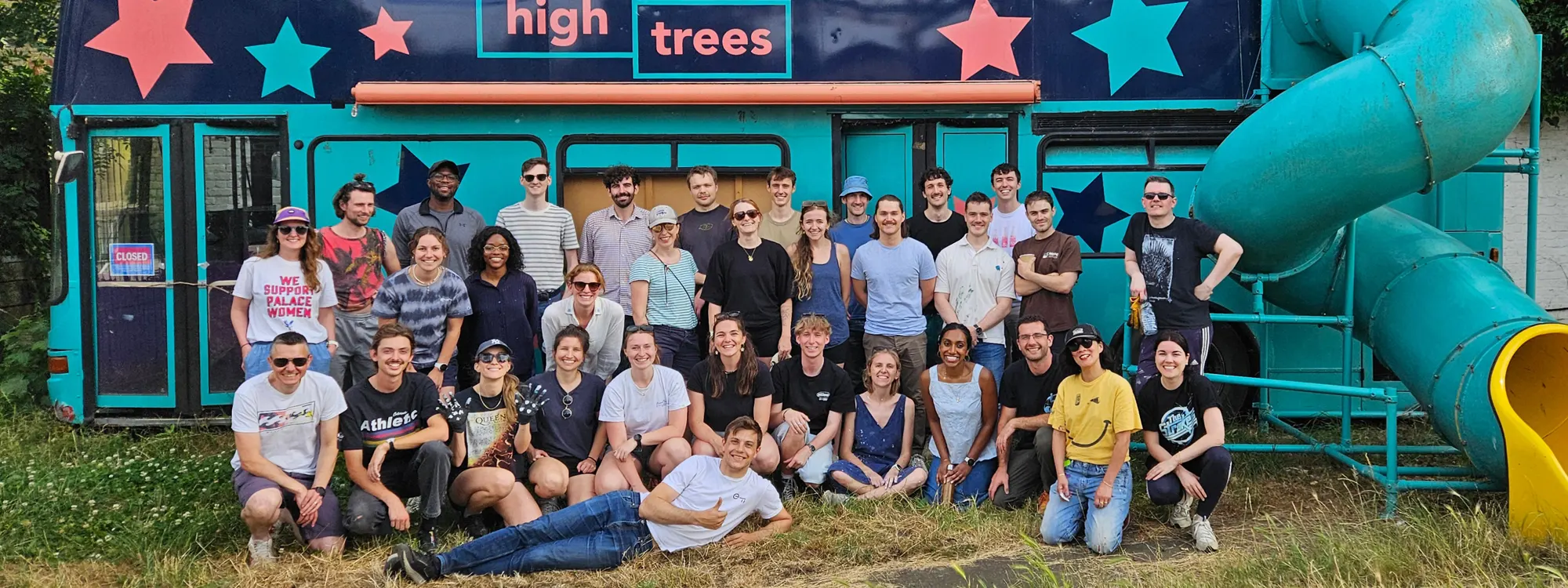
On Thursday 26 June, our team dedicated four hours to support High Trees at their Tulse Hill Adventure Playground – part of our annual Summer Social and ongoing commitment to community partnership.

High Trees has been established since 1998, addressing a reality we see all too often across London: young people in one of the world’s wealthiest cities still struggling to access opportunities that help them thrive. Their work spans adventure play, accredited adult education, employment support, and community programming across Lambeth.

Hands-on contribution

The adventure playground serves as a community project that requires ongoing maintenance to support the year-round programming families rely on.

By tackling practical improvements – such as refreshing paintwork across key buildings, clearing overgrown pathways to create more accessible play space, and organising storage systems – we directly enable High Trees to maintain the initiatives that create real impact in their community.

Why this matters

High Trees’ mission is straightforward: ‘helping people make meaningful changes to live happier, healthier, and more connected lives‘. The playground is an example of how sustained investment in public spaces creates lasting benefits – fostering early intervention, skill development, and connection to address challenges at their source.

Our Summer Social serves multiple purposes: it fulfills our annual commitment as a B Corp while strengthening collaboration across our diverse multidisciplinary teams. Most importantly, it demonstrates how we can support community development through direct contribution rather than just financial support.

Graham Weston, the Head of Community Action at High Trees, commented; “It was such a pleasure to host you at the Adventure Playground last week – your energy and teamwork made a real difference. The Playground is looking fantastic, thanks to your collective efforts. We really appreciate the time and care you put in to making an impact.”

A huge thank you to Graham and the entire High Trees team for accommodating us!

Learn more about the amazing work High Trees are doing on their website.

Bridging purpose and excellence

Insights from Catherine Ramsden’s IABSE Annual Lecture, integrating social purpose with design excellence.

On 29 May, our Founding Director Catherine Ramsden delivered the IABSE Annual Lecture, ‘Through the redline’, sharing valuable insights on integrating social purpose with design excellence. Her presentation addressed how the built environment industry can move beyond traditional metrics toward more holistic approaches, prioritising long-term impact and environmental responsibility.

A unique perspective on industry transformation

Catherine brought her distinctive perspective to the IABSE platform, drawing from her leadership of an award-winning B Corp and Social Enterprise that is renowned for delivering projects that stretch well beyond their boundaries and notional ‘redline’. Her approach bridges architectural innovation and community impact, offering rigourous frameworks for addressing the industry’s most pressing challenges.

Taking a journey through her work commencing with Mission Bay, California with efforts to rewild the natural wetlands, to loop in the positive ripple effects of the Millennium Bridge while at Foster + Partners and landing with current ambitions to propel material reuse in the recent salvaged steel pedestrian bridge and Brunel Engine Shed retrofit.

The discussion reinforced the sector’s readiness for approaches that balance rigorous technical standards with environmental responsibility and social impact, providing practical pathways for professionals seeking to create more meaningful outcomes through their work.

Watch the full lecture on YouTube.

Useful Simple Trust named ‘B Corp of the Year’

The Trust has been recognised for exceptional commitment to balancing purpose with impact at the 2025 British Business Awards.

Kate Boylan, Carrie Behar, and Carolyn Bowman with the Trust's 'B Corp of the Year' award

The Useful Simple Trust (UST) has been recognised as ‘B Corp of the Year’ at the prestigious 2025 British Business Awards, reinforcing our position as a leader in mission-driven business innovation within the built environment sector.

A celebration of business excellence

The British Business Awards stand as one of the UK’s premier platforms for recognising organisations that demonstrate exceptional leadership, innovation, and measurable impact across various industries. More than a simple accolade, these awards identify and elevate businesses that are actively transforming markets through responsible practices and forward-thinking approaches.

The ‘B Corp of the Year’ category specifically acknowledges organisations that exemplify how commercial success can align with – and indeed be driven by – unwavering commitment to environmental stewardship, social responsibility, and transparent governance.

Measuring what matters

UST’s achievement of a 123.3 B Corp score marks a 32% improvement from our previous certification, surpassing our 2027 target two years ahead of schedule. This score reflects our strategic focus on embedding impact measurement across all aspects of our operations, from project delivery to organisational governance.

“This recognition validates our long-standing belief that purpose and profitability are fundamentally interconnected,” notes our Head of Sustainability, Carrie Behar. “By setting ambitious targets and developing rigorous frameworks to track progress, we’ve been able to translate values into tangible outcomes.”

Leadership in practice

The award particularly highlighted several key aspects of our approach:

  • Our Climate Transition Action Plan provides a structured pathway to carbon neutrality by 2030, with clear interim targets and accountability mechanisms.
  • With 50% female representation on our Executive Board and 40% in leadership positions, our diverse team brings multiple perspectives to complex challenges.
  • Our comprehensive approach to learning, including our Future Skills programme and regular knowledge-sharing sessions, ensures our team remains at the forefront of sustainable design practices.
  • Through initiatives like ‘Useful Giving,’ we have invested over £51,000 in programmes that extend our impact beyond client projects, supporting education and innovation in the broader community.

As one of the UK’s first multidisciplinary design consultancies to achieve B Corp status, we have consistently advocated for systemic change within the built environment sector. Our active participation in industry bodies demonstrates our commitment to sharing knowledge and driving sectoral transformation.

The path forward

This achievement reinforces our determination to push boundaries in regenerative design and responsible business practices. Looking ahead, we are developing enhanced methodologies to measure our ‘project handprint’ – the positive environmental and social impacts of our work beyond basic compliance or standard practice.

We remain focused on strengthening our capabilities in areas such as circular economy principles, carbon literacy, and inclusive design. By continuously evaluating and refining our approach, we aim to create solutions that contribute meaningfully to a more equitable and regenerative built environment.

The 2025 British Business Awards recognition serves not as a culmination, but as a milestone in our ongoing journey to demonstrate how purpose-driven business can catalyse positive change at scale.


Advancing to Carbon Literacy Gold status

We have reached a significant milestone in our climate action journey, advancing to Gold certification as a Carbon Literate Organisation.

Gold Carbon Literate Organisation

The Useful Simple Trust (UST) has reached a significant milestone in our climate action journey, advancing from Silver to Gold certification as a Carbon Literate Organisation (CLO). This achievement demonstrates our commitment to embedding climate-conscious practices across our family of brands and throughout our organisational culture.

Our carbon literacy journey

Climate action stands at the heart of our ‘Get Set Zero’ initiative and unites all the Trust brands in a shared purpose. While many of our team members already operate as leaders in carbon reduction within their respective fields, we recognised the value of formalising and expanding this expertise through the Carbon Literacy Project’s certification framework.

The CLO accreditation uses a tiered system – Bronze, Silver, Gold, and Platinum – requiring increasingly robust commitments to climate action and low-carbon cultural transformation. Having achieved Silver certification last year, our progression to Gold reflects our organisational commitment to addressing the climate crisis.

Secured Gold status

Our certification journey involved several strategic initiatives:

  • Specialised Carbon Literacy (CL) training to 55% of our workforce, using materials tailored to the specific needs of organisations transforming the built environment.
  • Development of our first external-facing Carbon Action Plan (coming soon!), establishing a clear pathway to carbon neutrality that incorporates our employees action ideas generated during our CL training sessions.
  • Appointed dedicated sustainability leadership and embedded carbon literacy throughout our updated People Strategy, ensuring climate consciousness is present at every stage of an employee’s journey with the Trust.
  • Conducted a local needs assessment and initiated knowledge-sharing sessions with neighboring organisations in our Temple Chambers office building.

Impact beyond certification

This certification represents how CL has become intrinsic to our organisational identity. The 468 collective hours of learning across our team have translated into tangible changes in our operations, from updated procurement policies to refined recruitment practices.

Our CL initiative has strengthened our internal capabilities, enabling us to address complex challenges in climate resilience and develop net-zero strategies with greater confidence and expertise. By embedding this knowledge within our professional development processes, we ensure its lasting impact.

Collaborative climate action

As we continue our journey, our focus extends beyond internal practices to external collaboration and knowledge-sharing. Looking to the future, we aim to implement this by:

  • Expanding advocacy through our professional networks.
  • Partnering with organisations seeking to commence their own CL journey.
  • Continuing engagement with our community through planned learning sessions in 2025.

This achievement reinforces our mission to balance purpose with profit while establishing benchmarks for sustainable and responsible business practices. As we progress toward Platinum certification, we remain committed to sharing our experience and supporting others in their climate action endeavors.

Learn more about how you can become a Carbon Literate Organisation here.

Resource efficiency in the built environment

Catherine Ramsden joined the discussion with Circular., diving into the era where sustainability is no longer optional but imperative.  

Catherine Ramsden, the Studio’s Founding Director, joined the discussion with Circular., diving into the era where sustainability is no longer optional but imperative.  

In March, the United Nations warned that material extraction is expected to rise by 60% in 2060 – and this could ‘derail’ efforts to achieve global climate, biodiversity, and pollution targets as well as prosperity and human wellbeing.

The Circular Economy Foundation’s latest Circularity Gap Report found that the global circularity rate is falling, and we are consuming more virgin materials than ever – so our efforts to design better products and systems are currently dwarfed by global consumption.

Reflecting that the buildings and construction sector is the largest emitter of greenhouse gases at 37% of global emissions, Catherine commented:

“[we] now seem to have a better understanding of what embodied carbon associated with materials means, that there is a finite supply of resource, and that we have got to stop extracting it – and try to behave better. I think there is a big focus on measuring carbon and perhaps not enough about simply reducing it, and what we call lean design.”

In simple terms, Useful Studio, with colleagues in the wider Useful Simple Trust, create architectural and engineering solutions that use less stuff. To which Catherine added, “And that takes a rigour in design thinking, and sometimes more time.”