
 Under the Table is a series of conversations with leading architects and designers. It aims to explore the experiences and influences from childhood onwards that shape a practitioner. The series takes its name from the place Roger Tyrrell, and I’m sure many of us, first experienced the essentials of dwelling – under his parents’ kitchen table as a young child.
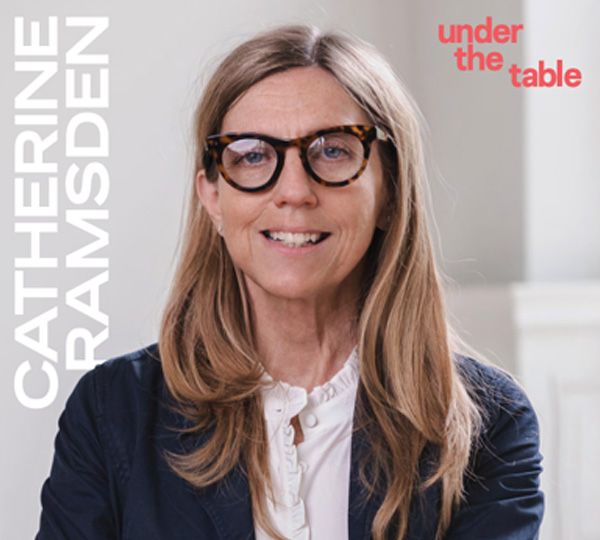
In this episode, we spoke with Catherine Ramsden, the Founding Director of Useful Studio, a multi-disciplinary collective of architects, engineers, and sustainability consultants working from a single open studio in London.
The practice is structured as an employee benefit trust and registered B Corp, a model Ramsden describes as a condition for freedom. Since founding the studio in 2013, she has led projects ranging from lean retrofit for heritage commercial assets to a family of motorway gantries for National Highways, and co-chairs the B Corp Built Environment Group. She sits on the National Highways Strategic Design Panel and the Dean’s Council at the University of Pennsylvania’s Weitzman School of Design. In 2025 she delivered the IABSE Annual Lecture, titled Beyond the Red Line and sits on the IABSE UK Executive Committee.
Before all of that, she was job captain on the Millennium Bridge in central London while at
Foster and Partners.
First Encounters
SOLUS: What was your first apprehension of architecture?
CATHERINE: It wasn’t really architecture. It was more construction, I would say, and materials. We had an opportunity when I was in high school, a careers course where you could visit a workplace. We went to law offices and accountants, but we also went to a steel mill. This visit left the biggest impression and made me most excited about what was possible in the world: to work with materials and resource, to be careful and respectful of those materials, and understand their potential, for cities, bridges and buildings. It was about craft, making and problem solving, really.
SOLUS: That respect for materials, that sense of responsibility toward them, where does it sit for you now?
CATHERINE: I feel humbled by them, genuinely. The behavioural shift in the studio is to look for a resource that exists already, or that is not interfered with, in its purest and most honest form, and go there first. Change the design sequence so that we capitalise on what exists before we start demanding new extraction. And be rigorous when considering new, highly machined and processed products that are manipulated to get to something then declared as innovative and circular. I’m not sure we’re doing the right thing with that approach. I’m interested in clients and organisations that have extensive assets already alongside new needs, and how to transition what exists, if redundant or outdated, into a new use that better deals with the challenges we’re facing. The beauty of something like tile: there’s a huge level of respect, longevity and performance, and you think, why would I create an overly complicated version of this? It’s so considered already.
SOLUS: Does your upbringing feed into this as well?
CATHERINE: Without doubt. We did a lot of travelling, road trips really, quite pared back. We spent time in tents; a lean approach, in nature. My father was a rocket scientist, a jet propulsion engineer, with an equal appreciation of technology, innovation and science alongside nature and spending time in the mountains.
When we were in Colorado, we visited a solar village. This is ages ago, before all the contemporary discussions around sustainability. There was a whole village geared around utilising energy as a natural resource to power homes: solar, and also trombe walls, which are thermal walls behind a glass pane that gather energy through the day and emit it through the night. It was this link between lean living in a tent, the ability to harness climate to create places to dwell, and my love of materials. I think that led me to consider architecture.
SOLUS: Your father sounds like a significant figure.
CATHERINE: He was. There was regularly a selection of partially assembled VW Beetles in the driveway. A solar hot water experiment in the garden, and making our own furniture. Taking care with materials, a sensitivity to climate and nature, with an overlay of innovation and technology. A spirit of experimentation. We had significant independence as kids, a lot of roaming around
and time for curiosity. I underestimated how much an impression this would make.
SOLUS: And your mother?
CATHERINE: She was a nurse, a children’s nurse. Very musical, excelling in history, and cooking, all the things I’m not particularly good at. But she had that same sense of not being wasteful. It was never an indulgent upbringing. There was a consistent set of behaviours around making the most of what we had. I talk about my father as the more obvious influence, but that quiet sense of responsibility and care, doing more with less… this could have been even more influential. When I go to a building and meet a client, I think: what have you got already? How can we problem-solve with the lightest touch? That’s her, I think.